[Reposted from How large the GenAI opportunity is & how to differentiate? | LinkedIn]

(Credit: DALLE3, with a prompt reflecting the content of this blog post)
Introduction
Yesterday marked a significant milestone in the Generative AI (GenAI) landscape — the first anniversary of the launch of ChatGPT. GenAI represents a major intersection of artificial intelligence and creative processes, producing new content, code, art, ideas, and more. From creating art to composing music, and from drafting code to providing medical advice, GenAI is revolutionizing numerous industries. As this field continues to evolve rapidly, understanding its landscape and opportunities is crucial for businesses, innovators, and consumers. This blog post builds up on my talk at GlueCon 2023 on GenAI opportunities and delves into the GenAI landscape, examining its market opportunities, and exploring strategies for differentiation in this rapidly evolving field.
GenAI Landscape
The GenAI landscape is evolving rapidly and looks vastly different to what it was during my talk at GlueCon 2023. Notable developments in this ecosystem since then include multimodal models, customizable foundational models, and push for small language models. We also witnessed significant investments, partnerships, acquisitions, founder coup (needs a dedicated post), and more! Check out how the landscape looks as of now, which is only going to keep evolving.

(Source
Here are more notable developments in this space this year:
- Microsoft’s Microsoft Copilot, offering a conversational interface across its platforms and the integration of DALL.E 3 into Bing.
- Google’s enhancements in generative AI at its Google Cloud Next conference, including the Duet AI assistant and new models from Anthropic and Meta Platforms Inc..
- Oracle’s OCI Generative AI service gives access to models from Oracle partner Cohere, emphasizing chatbots, summarization, and search applications.
- OpenAI’s launch of ChatGPT Enterprise, providing enterprise levels of security and privacy, and performance improvements.
- Salesforce’s Einstein 1 Platform and the Einstein Copilot for enhanced data integration and user experience.
- Meta’s Code Llama, a code focused LLM for generating code and natural language, highlighting the trend towards specialized models.
- Adept AI’s open-sourced Persimmon-8B LLM aimed at automating tasks, and consulting firm EY’s launch of EY.AI with its own LLM, EY.ai EYQ.
- Significant funding rounds and M&A activities, including AI21 Labs, Hugging Face, Writer, and Imbue’s raised funds, AWS’s acquisition of Hercules Labs, and Aivo’s acquisition by TimeTrade Systems.
These advancements showcase the dynamic nature of the GenAI field and its trajectory towards more specialized and regionalized models, reflecting the diversity and specific needs of global users.
GenAI Market Opportunity & Forecast
The market for GenAI is expanding at an incredible pace. Enterprises are leveraging GenAI across various verticals such as healthcare, finance, legal, and customer support, while consumers enjoy its benefits through entertainment, companionship, and personal assistance. GenAI market opportunity is expected to grow rapidly — one estimate plugs it to reach about $118.06B by 2032, while another one to $1.4T. Another study estimates that Generative AI has the potential to generate $2.6 — $4.4T in value across various industries. The driving forces behind this surge include advancements in language models and a growing demand for automation and personalization in services. And these numbers are just first-order effects — one can imagine the true potential for GenAI!
How to Differentiate?
While GenAI offers a spectrum of opportunities from better solutions to previously impossible feats, this field is much like the ‘Klondike gold rush,’ with new applications and sub-industries emerging rapidly. To differentiate in this booming ecosystem, consider innovating across any of these axes of ‘F’s — Foundation, Form, or Fit.
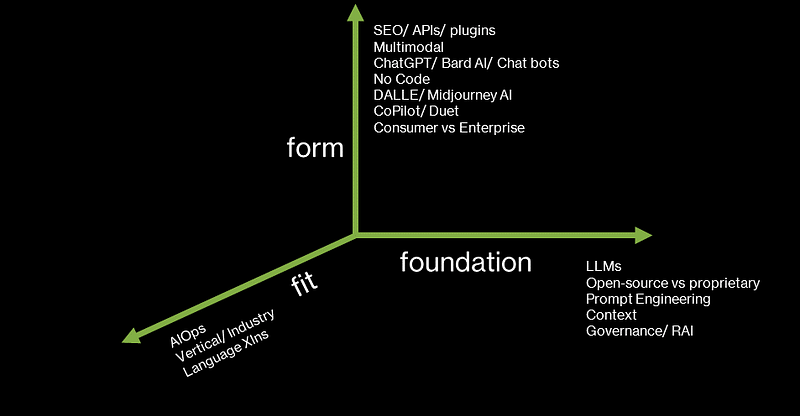
(Source: GenAI Opportunities, AI Meetup @ GlueCon, 2023, Sriram Subramanian)
- Foundation: This axis represents the underlying technology powering language models and includes, but not limited to enabling prompt-engineering, RAG, model governance, Responsible AI, enabling choices of open-source vs proprietary models, etc. This is also probably the most difficult axis to make an impact on.
- Form: This axis represents how GenAI capabilities are offered, such as chat agents, multimodal applications, copilots, etc. With customizable LLMs and multimodal LLMs, the barrier to innovate in this space has significantly decreased. This also means the need for real competitive advantage/ value, not just having data as moats.
- Fit: This axis represents building GenAI solutions to specific needs such as industry-specific AI applications, languages, AIOps solutions, etc. Strong domain expertise and an ability to leverage GenAI capabilities to solve domain specific problems would provide competitive advantage here.
It is interesting to note that many of the suggestions (such as multimodal models) from my talk in May 2023 are already a reality now. In such an exponentially evolving space, just pick one that suits your strengths and innovate!
Summary
Generative AI has revolutionized the way we interact with AI, offering vast opportunities for innovation and efficiency. As we reflect on developments this year, it is clear that GenAI’s potential is immense and still unfolding. Understanding its landscape, market potential, and differentiation strategies will be key for those looking to leverage this transformative technology.
#GenerativeAI #innovation #investments