Verdict: if you buy Claude through a cloud, the S-1 confirms what CIIB-006 argued. The cloud stands between you and Anthropic. It sees Anthropic's prices, provides cloud infrastructure and distribution for Claude, bills you and collects from you, and sells competing models. That arrangement carries 48% of Anthropic's revenue, and its cost to Anthropic rose, from about 8 cents of every revenue dollar in full-year 2025 to about 17 cents in the first half of 2026. The landlords took more of the building and more than doubled the rent. Enterprise customers live in that building.
On September 30, CIIB-006 read Anthropic's confidential draft prospectus through Reuters' reporting. We made four dated calls and promised a scorecard once the filing went public. Anthropic filed its public S-1 with the SEC on October 26, to list on Nasdaq as ANT.
We read the filing. One call was right outright, one is directionally supported, and one missed. The best forecast in CIIB-006 never made the scorecard: that the cost of the channel would rise. It more than doubled. The postulate stays open. Every figure below comes from the S-1 unless we mark it as our arithmetic.
The scorecard
| # | Call (30 Sep 2026) | What the S-1 shows | Grade |
|---|---|---|---|
| 1 | Rented Reach passes 50% in the latest reported period | Sales through CSP marketplaces were about 48% of revenue in H1 2026 | Missed |
| 2 | Gross booking stays; no restatement to net | Anthropic is the principal and recognizes marketplace revenue on a gross basis | Landed |
| 3 | Concentration eases: top two customers below 15% of revenue combined | No top-two figure disclosed for the latest period. No customer above 10% for the nine months to September; top five about 25% | Directionally supported; numerical threshold unverified |
| 4 | 60% of revenue through AWS, Microsoft and Google by 31 Dec 2027 | 48% in H1 2026, up from 44% in H1 2025 | Open |
| — | The re-netting gap widens if the 2026 fee rate rises (stated in Section 3, not scored) | Channel fees rose from about 8 cents per revenue dollar (FY 2025) to about 17 cents (H1 2026) | Landed |
Call 2 is the one investors should note. The filing states that cloud partners never take control of the service before it reaches the customer. That language is the basis for gross recognition, and we see nothing in the filing that would change it before listing.
Call 3 is directionally supported. Concentration eased sharply, from two customers at 12% each in 2025 to none above 10% for the nine months to September. Our test drew a 15% line for the top two. The filing reports a single-customer threshold and a top-five figure instead, which bound the top two between 10% and 20% of nine-month revenue. The top five held about 25%, so the largest two held at least two-fifths of that; no customer passed 10%, so two together stayed under 20%. The numerical threshold therefore remains unverified.
The reach is still climbing, more slowly
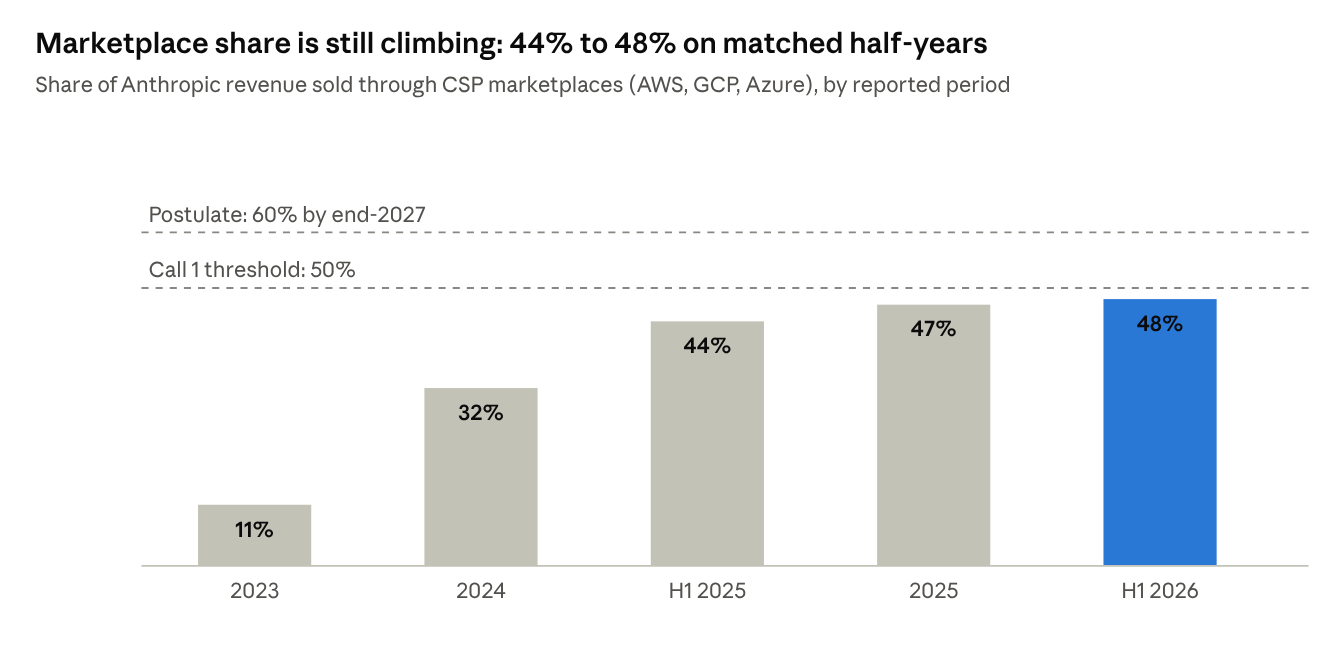
Source: Anthropic S-1, filed October 26, 2026 (Risk Factors; notes to the financial statements). Half-year bars are six-month periods.
On matched periods, the climb continues. Marketplace sales were 44% of revenue in the first half of 2025 and 48% in the first half of 2026, up four points in a year. Over that year revenue grew about 14-fold and marketplace sales about 15-fold (our arithmetic). The pace has slowed from the 15-point jump between 2024 and 2025, but CIIB-006's core observation holds: the share rose in every year the business grew.
The rent went up
The biggest finding in the S-1 is the fee line. Sales, marketing and partnerships expense reached $3.17 billion in the first half of 2026, or 19% of revenue, up from 10% a year earlier. The filing attributes most of the increase to a $2.7 billion rise in fees paid to channel partners.
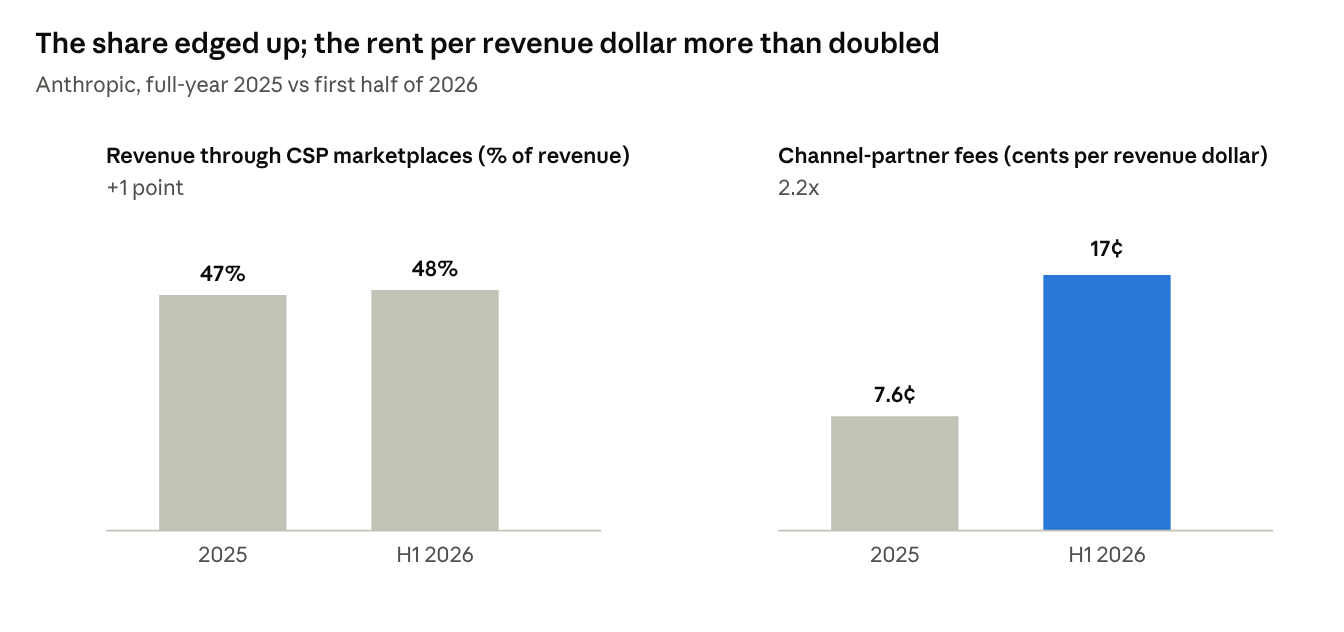
Share: Anthropic S-1. Fees: 2025 from Reuters' $351M estimate on $4.585B revenue; H1 2026 is CloudDon arithmetic from the S-1 ($2.70B to $2.82B on $16.29B), shown at the midpoint. Each panel has its own scale.
Our arithmetic puts first-half 2026 channel fees between about $2.70 billion and $2.82 billion. It adds two figures: the S-1's $2.7 billion year-on-year increase in channel fees (rounded in the filing), and first-half 2025 fees, which the S-1 does not disclose but which lie between zero and that half's $120 million of total sales and marketing expense. Either way, the fees came to 16.6% to 17.3% of first-half 2026 revenue. For full-year 2025 the figure was about 7.6%, using Reuters' $351 million estimate, which the S-1's $341 million year-on-year increase supports.
That comparison sets a half-year against a full year. The S-1 does not disclose first-half 2025 channel fees, but they cannot have exceeded that half's total sales and marketing expense of $120 million, or 10.3% of revenue. On matched half-years, the fee burden therefore rose at least 1.6-fold (our arithmetic).
Per marketplace dollar, the rise may be steeper. Marketplace sales were about $7.8 billion in the half (48% of $16.29 billion). If every channel fee went to the cloud marketplaces, they kept 35 to 36 cents per marketplace dollar. The same assumption puts 2025 at about 16 cents, Reuters' $351 million against $2.16 billion of AWS and Google marketplace sales. Neither filing nor reporting establishes that allocation, so both are conditional estimates, and up to about 36 cents is a hypothetical ceiling. Neither is a disclosed commission rate.
The re-netting gap moves with it. CIIB-006 put the 2025 cost of gross booking at about 7.6% of revenue and warned that the gap would widen if the fee rate rose. It did. As a sensitivity test on first-half 2026 numbers, netting out partner fees would take up to about 17% off revenue and lift any revenue multiple by about a fifth (our arithmetic). The operating loss is unchanged under either method. This is an analytical adjustment for comparison. The S-1 establishes Anthropic as the principal, and gross recognition follows from that.
The S-1 does not explain the jump. It says the expense line may move with changes in the terms of its channel partner arrangements. That makes the partner terms the first question for the roadshow.
Customers never see the fee on an invoice. Anthropic sets the price whether you buy direct or through a marketplace, and the S-1 cites that as a ground for booking the revenue gross. The rising fee raises the cloud's stake in your Claude spend. A higher fee gives the cloud more reason to sell Claude; its own models give it reason to sell something else. Your account sits between those two incentives.
What the S-1 leaves open
CIIB-006 argued that the 47% counted Amazon and Google only, leaving any Microsoft sales inside the other 53%. We took that split from Reuters' account of the draft. The public filing neither confirms nor refutes it.
The S-1 reports one figure for sales through "CSP marketplaces," with no breakdown by provider, and lists AWS, GCP and Azure as the marketplaces that sell Claude. For 2025, the Reuters split is plausible: Anthropic's Microsoft agreement dates from November 2025, too late to move the full year much. For 2026, Microsoft's marketplace sales most likely sit inside the 48%. Both are our inferences. If so, part of the Microsoft upside behind our postulate is already in the base.
The filing settles one definition in our favour. Rented Reach is now a disclosed metric. Anthropic reports the share of revenue through CSP marketplaces in both the risk factors and the notes to its financial statements, so we will track the S-1 figure from here.
Concentration eased. The S-1's customer table shows two customers at 12% each in 2025, which matches Reuters' report. One customer reached 18% in the first half of 2025 and one sat at 11% in the first half of 2026. For the nine months to September 30, no customer passed 10% of revenue. We had flagged this as our weakest call.
What the S-1 tells Claude customers
Anthropic's risk factors read like a buyer's checklist.
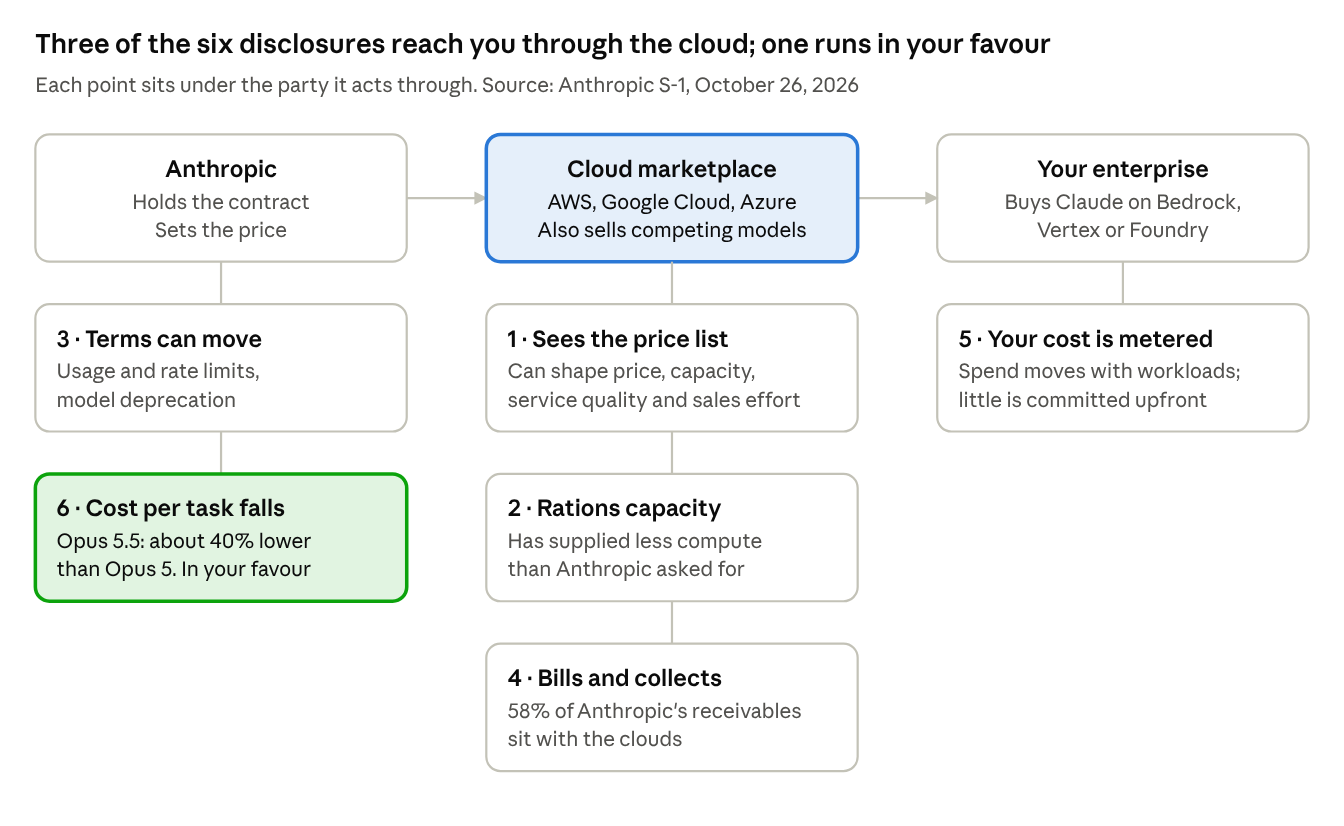
Six customer disclosures in Anthropic's S-1, placed under the party they act through.
- The cloud sees the price list. Amazon, Google and Microsoft have visibility into Anthropic's pricing and commercial terms across their platforms. Anthropic warns this may shape their pricing, compute allocation, service quality and sales prioritization. The filing names the clouds' roles in one line: "investors, customers, distribution partners, and competitors."
- Capacity is rationed upstream. Anthropic says it has asked the clouds for more compute than they were willing to provide, and that they may put their own needs first. A shortfall upstream reaches your account as rate limits or slower service.
- Terms can move. Anthropic has changed usage limits, rate limits and model capabilities before, and says it may again. It also flags forced model deprecation as a source of customer disputes.
- Your payments run through the cloud. At June 30, 58% of Anthropic's net receivables came from CSP marketplace sales, about $3.4 billion of a $5.8 billion balance (our arithmetic). For marketplace buyers, the cloud bills and collects while Anthropic holds the contract.
- Your cost is metered. Remaining performance obligations were $10.8 billion against about $46 billion of annualized revenue (our arithmetic). Most Claude spend is usage that moves with your workloads, and net revenue retention was about 900%.
- One disclosure runs in your favour. Anthropic says Claude Opus 5.5 cut customer cost per task by about 40% against Opus 5. The price of a task is falling even as the channel takes more.
Subscriptions work as a bridge into the meter. Anthropic sells Pro and Max to individuals and Team and Enterprise to organizations. Subscriptions brought in $3.2 billion in the first half of 2026, 20% of revenue, up from 17% in 2025. A subscriber who hits a tier's usage limit moves up a tier or buys usage directly. Enterprises that sign non-cancelable minimum-spend contracts get a committed price list in return.
Agents are the product, and they cost more to serve. The S-1 says customers frequently use Claude Code and Cowork for long-running autonomous work, and Claude Managed Agents runs the agent loop on Anthropic's compute, credentials and memory included. Anthropic calls agentic offerings structurally more compute-intensive and may move them to outcome- or task-based pricing. Agents can act faster than human reviewers can check, and the filing calls full audit trails technically hard. Feature availability also varies by deployment, which matters if you buy through a cloud.
Where the postulate stands
We hold the postulate. By the end of 2027, at least 60% of Anthropic's revenue in a reported period will come through AWS, Microsoft and Google.
The S-1 shows the share rising about four points a year on matched half-years. A linear extrapolation from 48% in the first half of 2026, at four points a year over the 18 months to December 2027, gives about 54% (our arithmetic). That is an extrapolation, and the filing makes no such forecast. Sixty needs the pace to roughly double.
We still expect the clouds to get there, and the fee line is why. Anthropic more than doubled what it pays the channel per revenue dollar between full-year 2025 and the first half of 2026, and the S-1 says it intends to deepen its cloud distribution partnerships. Our read: a lab does not pay rising rent on a channel it plans to leave.
Our tripwire: if the marketplace share is still below 50% in the 2026 annual report, the postulate is failing, and we will say so in print.
Recommendations
In priority order.
- Enterprise buyers: map your Claude spend by channel before renewal. Know which workloads run directly through Anthropic and which through Bedrock, Vertex or Foundry. Compare pricing, model availability, agent features and operational limits across channels. The same model does not necessarily mean the same service.
- Enterprise buyers: negotiate capacity, continuity and pricing together. For critical workloads, seek contractual commitments on capacity, rate limits, model retirement notices and migration windows. Choose deliberately between seat-based subscriptions, metered usage and minimum-spend contracts. For agentic workloads, secure pricing protections before task- or outcome-based billing arrives.
- Enterprise buyers: treat agent governance as a procurement requirement. Specify what audit logs, tool-call records and approval controls are available, who manages credentials and memory, and where human authorization is required. Require visibility into agent execution and costs. Do not assume that governance capabilities available directly from Anthropic are available through every cloud channel.
- Enterprise buyers: preserve negotiating leverage. Cloud providers are simultaneously Anthropic's investors, infrastructure suppliers, distributors and competitors. Avoid unnecessary dependence on a single distribution path. Evaluate whether alternative channels offer comparable capacity, features and commercial terms, and establish an exit path before workloads become difficult to migrate.
- Founders building on Claude: protect unit economics and model portability. Price your products against the cost of a completed task, with token consumption as one input. Stress-test margins against rising agent compute requirements, potential pricing changes and marketplace fees where applicable. Keep a second model viable for critical workloads; portability is cheaper to build before you need it.
- Investors: normalize distribution economics and watch agent compute. Run a net-revenue sensitivity by subtracting estimated channel-partner fees, up to about 17% of first-half 2026 revenue, when comparing Anthropic with companies reporting revenue net of intermediary fees. Treat it as an analytical adjustment; Anthropic's gross recognition stands under GAAP. Track marketplace concentration, fee burden and agent compute intensity separately: distribution costs and inference costs are distinct pressures on margins.
Recommendations for Anthropic
Anthropic cannot fully control its distribution partners, but enterprise customers still expect a consistent Claude experience across channels. Five gaps remain between what the S-1 discloses and what customers can reliably expect.
- Publish the channel mix by cloud, every quarter. Disclose the revenue shares attributable to AWS, Google and Microsoft, alongside the blended channel-partner fee rate. The S-1 reports one combined CSP marketplace figure, obscuring the distribution concentration and economics investors need to assess.
- Align model retirement notices across cloud channels. Work with AWS, Google and Microsoft to establish a minimum 60-day notice period for model retirement, with published channel-specific migration schedules. Customers should not face materially different migration windows for the same model simply because of where they buy it.
- Restore committed capacity for frontier models. Offer enterprise customers contractual capacity commitments for current models, directly or through cloud partners. Publish eligibility criteria, service guarantees and remedies for capacity shortfalls. Priority without a commitment is not capacity assurance.
- Publish an agent-pricing transition policy. If Anthropic moves toward task- or outcome-based pricing, provide advance notice, clear conversion rules and protection for existing contractual commitments. Enterprises should be able to forecast agent economics before adopting a new pricing model.
- Establish a consistent agent auditability baseline across channels. Provide configurable logging of agent tool calls, approvals and execution outcomes across Anthropic-hosted and cloud-partner deployments, with enterprise controls for retention and sensitive data. Auditability should not depend on which cloud sells the model.
Conclusion
CIIB-006 asked who owns the customer. For the half of Anthropic's revenue that runs through a cloud, the S-1 gives a clear answer: the cloud controls critical elements of distribution, billing, collections and infrastructure, while Anthropic retains pricing and contractual authority. And Anthropic now pays about 17 cents of every revenue dollar for the cloud to carry the sale.
If you buy Claude through a cloud, you are a tenant in that building too. Know which of your AI spend runs through which cloud, and get in writing how that cloud treats Claude against its own models.
We will publish a full CIIB once the roadshow puts the partner terms on the record.
Sources
- Anthropic, PBC, Form S-1 registration statement, filed October 26, 2026: Risk Factors; MD&A; notes to the consolidated financial statements (concentrations, revenue recognition, remaining performance obligations).
- Anthropic, Anthropic files S-1 with the SEC for proposed initial public offering, October 26, 2026.
- CloudDon Research, CIIB-006: Anthropic Pays Rent to Its Rivals. Who Owns the Customer?, September 30, 2026.
- Reuters, "Exclusive: Anthropic IPO prospectus lays bare deep dependence on Big Tech partners," September 29, 2026, as cited in CIIB-006.
- Anthropic, Claude Code feature availability by provider (Amazon Bedrock, Google Cloud's Agent Platform, Microsoft Foundry); Model deprecations; Service tiers; Monitor Claude Cowork activity with OpenTelemetry. All accessed October 26, 2026.
Figures marked as our arithmetic are CloudDon calculations from S-1 figures. Research for informational purposes only. Not investment advice.