Anthropic’s S-1 Proves the Growth. The Profit Is Thin.
Verdict: Anthropic's S-1 is the most detailed account any frontier lab has published, and it proves the growth. It also shows how thin the profit is. Across the first half of 2026, Anthropic lost 8 cents for every dollar it spent on compute. In its one profitable quarter, it earned 18 cents. The clouds that rent it that compute earn 57 to 71 cents of operating profit per dollar of cost. OpenAI will file into the bar Anthropic set, and it will be held to the same standards that Anthropic set, and possibly more.
Anthropic filed its public S-1 on October 26 to list on Nasdaq as ANT. Reports put the raise at up to $100 billion and the valuation at $1.5 trillion to $2 trillion, with pricing expected in Thanksgiving week. Our free scorecard graded CIIB-006 against the filing. This note asks the investor's question: what does a compute dollar earn? Every figure comes from the S-1 unless we mark it as our arithmetic.
The growth is real, but slowing in dollars
Quarterly revenue rose from $376 million in Q1 2025 to $11.6 billion in Q2 2026. Q2 also delivered a GAAP operating profit of $974 million, the first in six reported quarters. Net revenue retention was about 900%, and customers paying $100,000 or more a year grew from 950 to 11,900 in twelve months.
The number to watch is the increment. The S-1 puts Q3 revenue at 86 times Q4 2024's $197 million, about $16.9 billion (our arithmetic). That adds about $5.4 billion, against $6.8 billion in Q2. The filing links part of the slowdown to stepped-up enforcement against customers who break its usage rules. It estimates those customers produced 5% to 7% of nine-month revenue.
What a compute dollar earns
We introduce a new metric to track this, Operating Profit per Compute Dollar (OPCD): GAAP operating income divided by compute and infrastructure expense. It covers the whole business, inference and training alike. It measures operating performance and says nothing about return on capital. OPCD is a CloudDon framework, and we will track it for every frontier lab that reports.
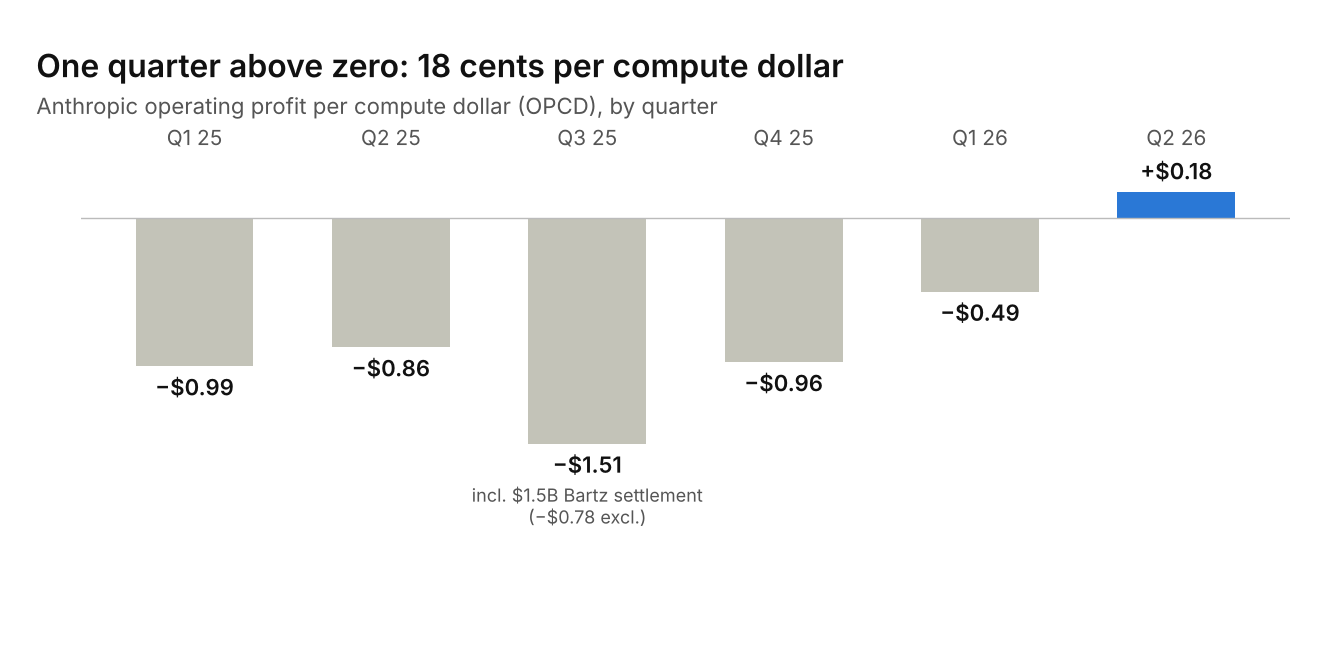 Source: Anthropic S-1, quarterly results of operations; CloudDon arithmetic. All 2026 figures are unaudited.
| OPCD (our arithmetic) | FY2025 | Q1 2026 | Q2 2026 | H1 2026 |
|---|---|---|---|---|
| GAAP operating income | −$8.06B | −$1.67B | +$0.97B | −$0.69B |
| Compute and infrastructure | $7.33B | $3.39B | $5.56B | $8.95B |
| OPCD | −$1.10 | −$0.49 | +$0.18 | −$0.08 |
As the readers are well aware of, revenue and profit are different numbers. In H1 2026, Anthropic took in $16.29 billion, paid $8.95 billion for compute and an estimated $2.70 billion to $2.82 billion in channel-partner fees. That leaves about 51 cents of contribution per compute dollar. Staff, marketing and everything else consumed it and more. The roughly 85% reported gross margin uses Anthropic's allocation of customer-serving costs, including a portion of its shared compute pool. OPCD instead charges the entire compute and infrastructure expense against operating income, including compute used for research and model development. They answer different questions. Q2 numbers are encouraging and unproven. Revenue grew faster than compute contracted a year or more earlier, and the S-1 itself expects pricier short-term compute to compress margins. It has to be noted that one quarter is just a turn, not a trend.
The landlords earn more
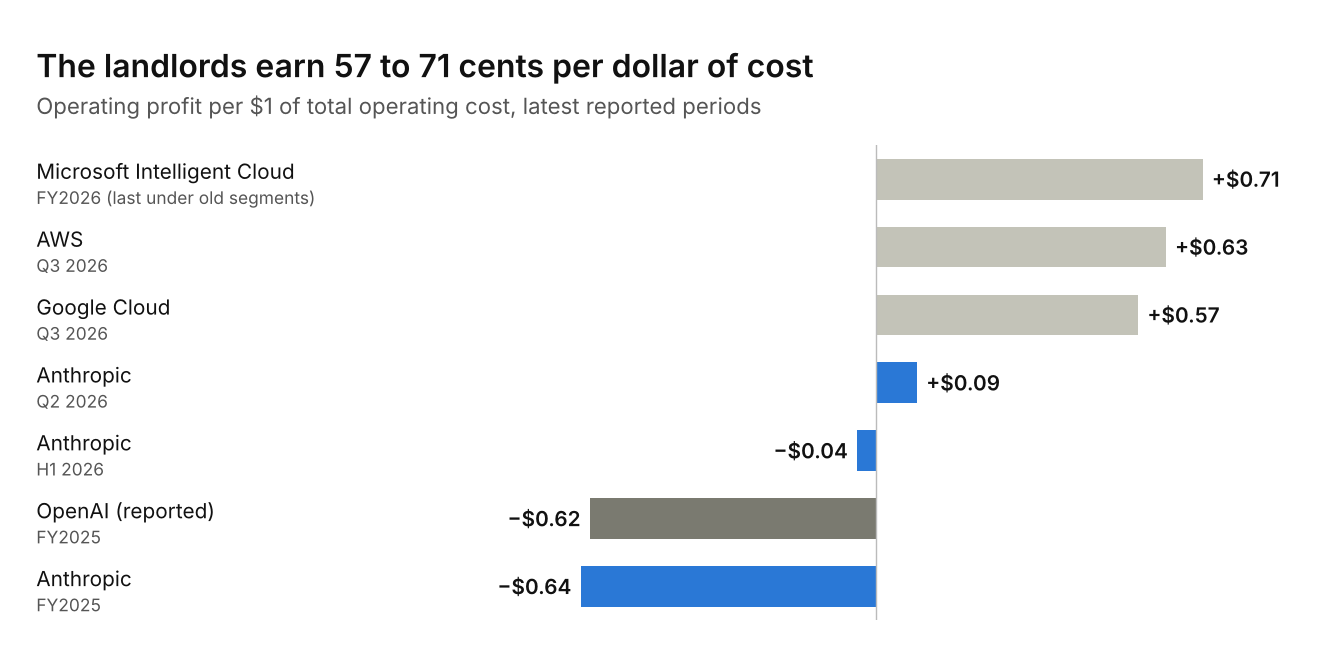
Sources: Anthropic S-1 (CloudDon arithmetic); AWS and Google Cloud Q3 2026 segment results; Microsoft Intelligent Cloud for fiscal 2026, the last period under that segment; OpenAI 2025 from leaked statements reported by Where's Your Ed At and the Financial Times. Directional: business mix and cost allocations differ.
The cloud segments do not disclose compute expense, so this chart uses operating profit per dollar of total cost. With those caveats, the gap is still wide: the companies that rent Anthropic its compute and sell its models earned 57 to 71 cents per dollar of cost in their latest periods, against 9 cents for Anthropic in its best quarter.
The bill is already signed. Compute minimums with Google, Amazon and Microsoft, plus Broadcom equipment leases, total about $431 billion, roughly nine times Q2's annualized revenue (our arithmetic). About 80% of revenue is metered usage that customers can turn down.
What OpenAI should be asked for
Anthropic's run-rate formula, concentration table, marketplace share and rule-breaker revenue estimate are now the floor. Three missing disclosures matter most, for Anthropic's amendment and for OpenAI's filing:
- Gross margin by product. What the API, Claude Code, subscriptions and agents each earn.
- Channel economics by cloud. Revenue and fee rate for AWS, Google and Microsoft separately. Channel fees took about 17 cents of every revenue dollar in H1 2026, more than double the 2025 rate.
- Agent unit economics. The S-1 says agents cost more to serve. It does not say how much more.
OpenAI adds one item Anthropic has no equivalent for: Microsoft's revenue share, in dollars. And because OpenAI is reported to book only its share of some partner sales, every comparison will need a gross-to-net bridge.
Our calls
- The IPO prices at $1.5 trillion or more by 31 December 2026.
- Q4 2026 adds fewer revenue dollars than Q3's roughly $5.4 billion.
- Compute rises above Q2 2026's 48% of revenue in at least one half of 2027, as contracted capacity lands ahead of revenue. We read Q2 as a temporary low.
Our base case is a SpaceX replay: a record raise, a strong first day, then a repricing on the first two reports as a public company. By then, profit per compute dollar will matter more than run rate.
The full analysis will be published as CIIB-007, for subscribers with all seven missing disclosures, the Anthropic-OpenAI comparison table, four IPO scenarios with our odds, seven dated calls, and recommendations for investors, enterprise buyers and founders [link will be updated soon].
Sources
- Anthropic, PBC, Form S-1 registration statement, filed October 26, 2026.
- NPR, AI giant Anthropic files for an IPO that could break records, October 26, 2026.
- Beancount, Microsoft FY2026 earnings analysis, for Intelligent Cloud's fiscal 2026 results.
- Stock Titan, Alphabet Q3 2026 earnings and Amazon Q3 2026 earnings, for Google Cloud and AWS Q3 2026 results.
- Let's Data Science, OpenAI reports rapid revenue growth, larger losses, summarizing leaked 2025 statements reported by Where's Your Ed At and the Financial Times.
- IPOScoop, SpaceX climbs 19% in Nasdaq debut after record IPO, June 12, 2026.
- CloudDon Research, CIIB-006: Anthropic Pays Rent to Its Rivals. Who Owns the Customer?, September 30, 2026.
Figures marked as our arithmetic are CloudDon calculations from S-1 figures. OpenAI figures are press reports, not filings. Research for informational purposes only. Not investment advice..